Euro-Mediterranean meeting: Past, Present and Future ; on Globalization and the Arab states
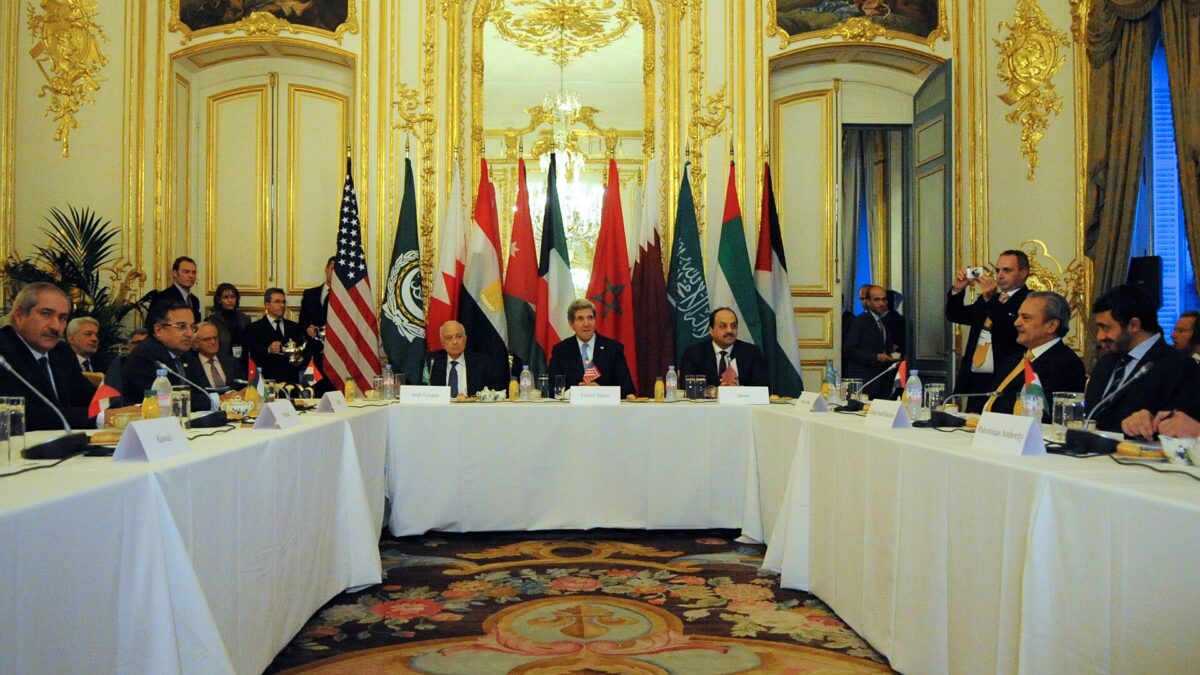
Deliberations of the " Euro-Mediterranean meeting: Past, Present and Future in relations" were held in Damascus on March 26 through 29 at the Damascus Meridian Hotel and al-Assad Library.
They were organized by the " Complutense " Institute for International Studies and the federation of Syrian Chambers of Commerce. Among the main topics read during the four Ð day deliberations were " The European Union and Syria: An evolving relationship;" The " Framework of the Association Agreements ;" " Political Aspects of the Association Agreements ;" " the impact of the Association Agreements ': Globalization and economic development;" The development co-operation for the Reform and strengthening of institutions," " Partnership, public Administration and Social agents ;" " Public administration reform for a better Euro-Mediterranean partnership;" " the contribution of Social Agents to partnership," " the challenges of the partnership," and " Syria in the Information Society, and the Information Society as a Challenge for the promotion of Knowledge."
In his research the " Impact of Globalization in the Development of Arab Countries," the secretary General of the " Arab Thought Forum" Ali Ahmed Attiga said that Globalization presents Arab and other developing countries with some serious problems of structural and policy nature. He in the first place noted the problem of global competition with transnational corporations. They offer a form of unfair competition between inefficient enterprises in developing countries on the one hand, and large efficient enterprises with accumulated knowledge of technology and management, acquired market shares and strong equity structure. He said that competition under such conditions, if left to its own forces, can only lead to more concentration of economic power in the hands of transitional corporations. This trend has become already evident in basic sectors of energy, technology and the services industries, where the scope for free competition is reduced, rather than increased, through globalization.
He indicated another key problem with the way globalization is currently developing has to do with its selective nature. Thus, while it advocates global competition for trade and finance, the opposite is the case for labor movement across national borders. The same is true for access to innovation and technology. Globalization has brought with it increasing restrictions on the flow of intellectual property rights with higher costs of acquisitions.
Attiga continued that a third problematic area with globalization is that the rules of its game are largely decided by the powerful players.
Thus all questions of technical specifications and standards and all non- tariff barriers are unilaterally decided and enforced by countries that can afford to make such decisions.
In his debate Attiga assumed that Arab regimes would accept to formulate and implement a long Ðterm strategy for economic integration and political co-operation among themselves, either on a bilateral or a regional scale. He continued that for this assumption to be valid, Arab regimes would have to overcome current problems for better understanding and build a new base of mutual confidence. This will require time, patience and favorable external circumstances.
He also indicated another basic assumption which is the acceptance by Arab states of the feasibility and necessity of joint Arab economic schemes designed to serve their common interests and future need. He said: " If they accept a long range strategic commitment, issues of bilateral or regional differences would not be allowed to stand in the way of joint action towards common development and regional security."
He cited a good example of this kind of strategic approach is the way Spain and the UK have handled their differences on the question of sovereignty over Gibratar. They did not allow this issue to hinder their co-operation and joint commitment within the European Union..
He also noted a third basic assumption for the validity of this optimistic scenario is a long-range commitment of Arab governments to the need for political development, aimed at the achievement of more effective participatory political system based on the rule of law.
He recommended consolidation of existing and potential inter- Arab governmental regional institutions. He said, at Present there is the Gulf Co-operation Council GCC and the Maghreb Union. So far, the GCC has been more successful in consolidating the work of its member states, while the Maghreb Union is just beginning to function, after a long period of stagnation. He added that a Third council, consisting of Egypt, Jordan, and Yemen automatically ceased to exist after the Gulf crisis of 1990.
He said that in addition to the above three regional councils, it would seem that there is need for a fourth group, consisting of Egypt, Sudan and Libya, and may be later on, Somalia and Djibouti. He explained that this arrangement would mean that Egypt and Libya would be members of two adjacent regional groups, which is justified due to the geographic location, as well as the cultural and demographic affiliations of these two countries.
He added that the energy and transportation infrastructure should provide a common link of interdependence within, and between, these regional groups. Fortunately, he said, there has been considerable progress in these two vital forms of infrastructure, noting there is still a pressing need to complete the connections and improve the quality of roads and air transportation, together with the establishment of regular modern shipping lines. He noted that there is a promising beginning in the case of energy. Already there are functioning electric power connections between several countries in the Arab Maghreb and between Egypt, Jordan and Syria. It is necessary to extend the Arab power grid to supply all Arab countries on regional and inter- regional basis. There is also a need for establishing gas pipelines between Arab countries in different regions. Already there is a plan for such a pipeline between Egypt, Jordan, Syria and Lebanon.
He continued that as for overall Arab co-operation and policy co-ordination, there is a pressing need for reviving and upgrading the functions of the Arab League and other intergovernmental specialized institutions, after a thorough review of their relevance and potential in view of recent global developments. Also, national and joint Arab financial institutions and development funds should be strengthened as means of supporting joint regional infrastructure and other development needs, he recommended.