Al-Assad receives US Churches for Middle East Peace delegation
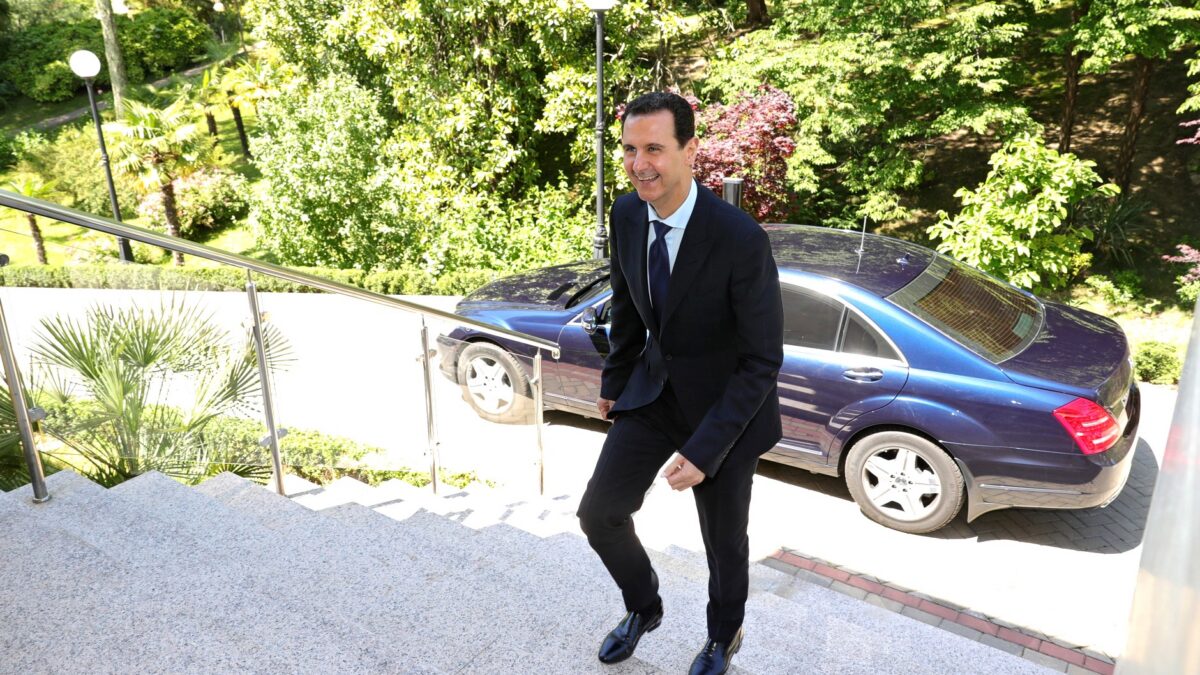
Syria's President Bashar al-Assad discussed Sunday the importance of the joint coexistence and dialogue on all levels among all divine religions calling for amity, clemency and humanity.
That came when President al-Assad received the US delegation of Churches for Middle East Peace at al-Shaab Palace.
The organization had previously said that "a delegation of 12 will include CMEP Board and staff members, accompanied by CMEP Leadership Council members. Corinne Whitlatch, CMEP Executive Director and Julie Schumacher Cohen, CMEP Legislative Coordinator, will be with the delegation .. Among the issues CMEP will be studying and discussing with both Israelis and Palestinians is Jerusalem"
Churches for Middle East Peace (http://www.cmep.org/) describes itself as "a coalition of 21 public policy offices of national churches and agencies -- Orthodox, Catholic and Protestant. CMEP began its work in 1984 out of the conviction that the policy perspectives and long Middle East experience of our member bodies should be more widely known in the public policy arena. We therefore seek to maintain an on-going dialogue with Congress, the Administration and the diplomatic community, to advance such concerns, assessments, and advocacy positions ... Among our principal advocacy concerns are: the avoidance and resolution of armed conflicts, human rights, arms control, foreign aid, and the unique nature of Jerusalem - sacred to Christians, Jews and Muslims."
The organization noted a Haaretz article that said about the Kadima party, that won the Israeli elections, that regarding the city of Jeruzalem "Kadima revealed some details of its vision of a divided Jerusalem yesterday, saying a future Palestinian state would include the East Jerusalem neighborhood of A-Tur, but not the Old City. 'The Old City, Mount Scopus, the Mount of Olives, the City of David, Sheikh Jarra will remain in our hands, but Kafr Akeb, A-Ram, Shuafat, Hizma, A-Zaim, A-Tur, Abu Dis are not part of historic Jerusalem, and in the future, when the Palestinian state is established, they will become its capital,' said Otniel Schneller, a former leader of the Yesha Council of settlements who represented Kadima at a debate on dividing Jerusalem. The debate was held at the Jerusalem Institute for Israel Studies."
The president and the delegation reviewed the necessity of ensuring requirements of security and stability in the region.
President al-Assad reminded of Syria's continued endeavors for achieving peace in the Middle East and her commitment to the UN resolutions for being the reference for the realization of security, peace and stability in the region.