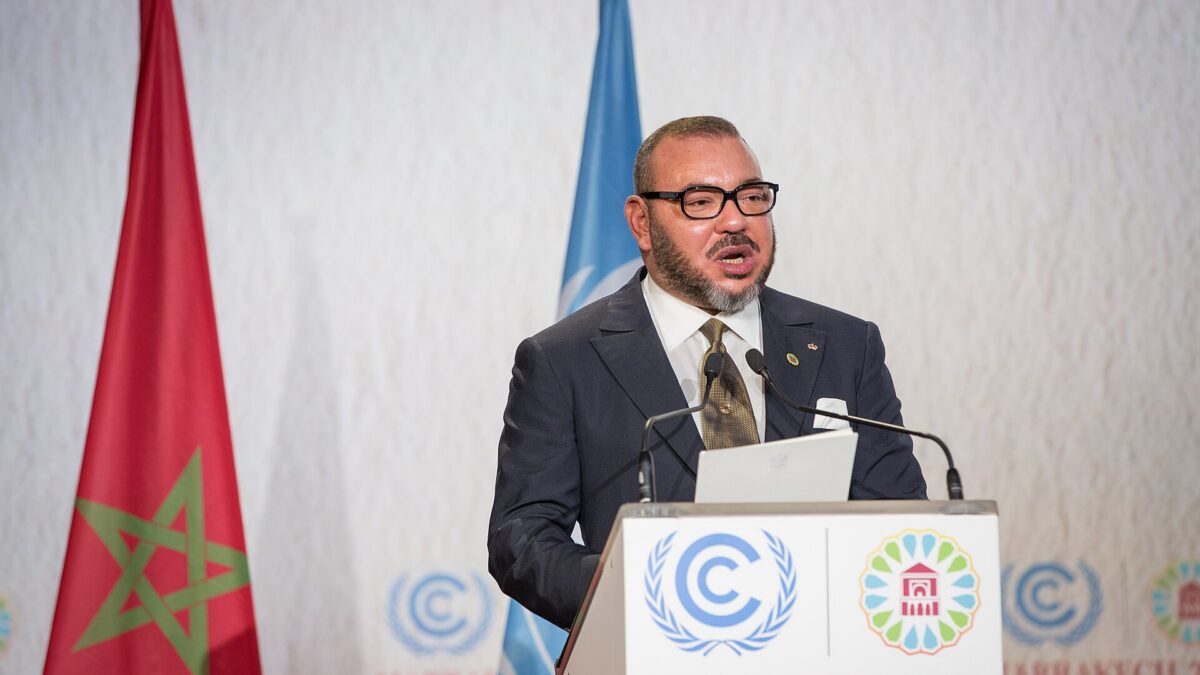
King Mohammed VI will lay foundation stone of new Casablanca Grand Stadium
King Mohammed VI will lay on Monday the foundation stone of Casablanca Grand Stadium with a capacity of 100,000 spectators to be built as part of the Moroccan preparations for the 2006 World Cup soccer finals.
The king will give the green light for the construction of the new stadium, part of a 10-day tour he starts this Monday to 13 Moroccan northern provinces.
The construction of a new stadium in the Moroccan metropolitan city of Casablanca has become a necessity in the country's bid to host the World Cup in 2006.
Morocco is competing with fellow African nation South Africa, as well as Germany, England and Brazil to host the planetary event. Observers believe that the race for winning the bid is between Morocco and South Africa, as FIFA (world football governing board) wants to entrust an African country with hosting the World Cup.
FIFA is to select next July 6 the host country of the World Cup finals.
Although Casablanca, which has a 4.5-million strong population, already hosts a number of stadia, the authorities want to build a new one to consolidate Morocco's chances to win the bid.
Other large stadia are to be built in the cities of Settat, El-Jadida, Marrakesh, Agadir, Rabat, Tangiers, Fez, Meknes, Oujda and Nador.
No exact figure has so far been disclosed on the budget earmarked to the drive, but the authorities said that they will not hesitate to invest as much as $600 million on sporting facilities alone.
Morocco bets on its quality as a secure and stable country, as opposed to South Africa where the lack of security remains a black point, despite its developed infrastructure.
The kingdom's proximity to Europe is another strong point in Morocco's bid. A two-hour flight to Europe allows Europeans to come to Morocco to watch a match and return to their countries.
Furthermore, Morocco's record as the first African country to qualify for the World Cup in 1970 and as the first African nation to make it to the second round of the World Cup (Mexico 1986) is another aspect that makes of Morocco a football nation par excellence and that consolidates its odds.
Part of its efforts to sway world opinion towards its bid, Morocco rallied last week several African football and art stars and made them ambassadors.
These include renowned Senegalese signer Youssou n'dor, who sang the official song of the 1998 World Cup in France, singer Salif Keyta of Guinea, winner of the Golden Disc and best-seller for 5 years.
The African football stars included winners of the African Golden Ball: Salif Keyta of Mali, Mamadou Kamara of Guinea, Ahmed Faras, Mohamed Timoumi and Baddou Zaki of Morocco.
Morocco's World field and track champion, Hicham El-Guerrouj and Nezha Bidouan, former World champion (women's 400 m hurdles), were also chosen to defend Morocco's bid.
Morocco also relies on the backing of fellow Arab nations, especially those having a strong say in the FIFA, to bring the planetary competition to an Arab land for the first time in history.