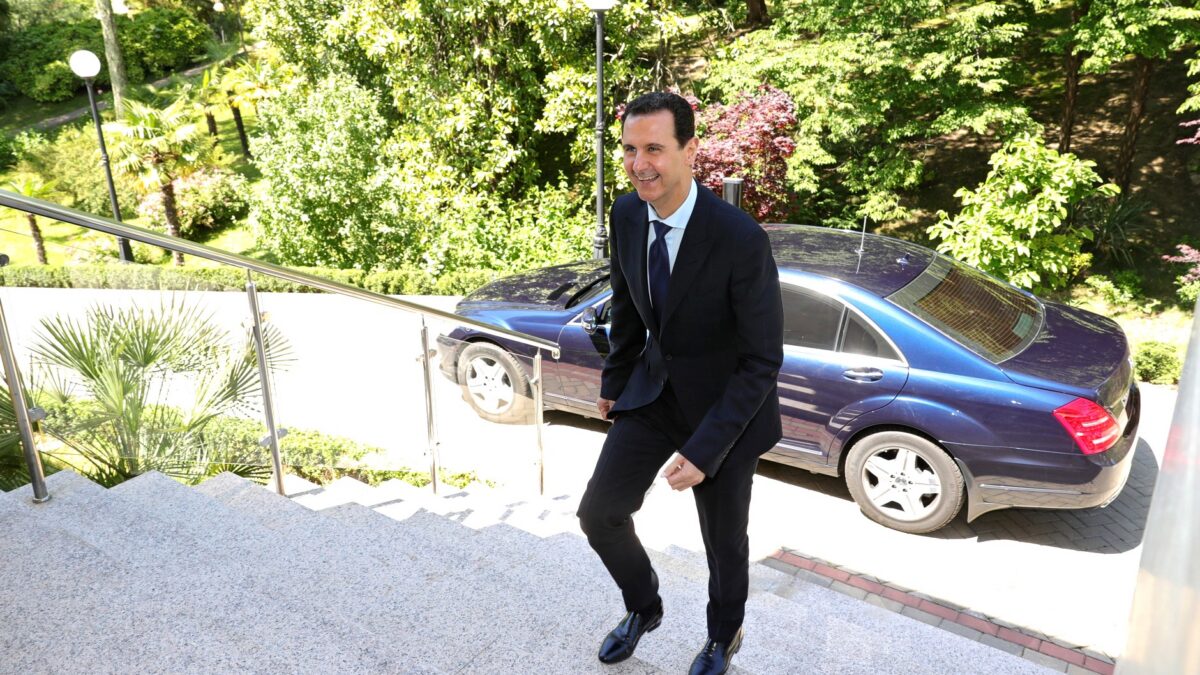
President al-Assad's address on taking oath of office: Peace with Israel will not be made before settling inter-Arab disputes
Syrian President Hafez al-Assad on Thursday took the oath of office at the people's assembly (parliament) on the occasion of the start of his fifth, seven-year constitutional term.
On the internal level, the President highlighted the achievements realized in Syria under his chairmanship. "During the last 30 years we have realized great achievements in various walks of life. In the building of sound economy, services, education, culture, sciences and the arts. Syria has built a solid base which has enabled her to move towards a brighter future," he said, adding, "We worked to consolidate our material structure by constructing a strong national base, despite being besieged by problems and complexities imposed by regional and international conditions."
The president said that despite the great efforts exerted to develop the state's systems and institutions, "There are still some areas that should be dealt with to modernize the state and enable it to perform its tasks in serving the people and ensuring their needs."
On the economic level, the president said that since he came to power in November 1970 great attention has been paid to the national economy and an economic base was built. "We are committed to comprehensive development as a national responsibility to the state and society," he said, "In the next stage, we have to concentrate on balance in the national economy by working to increase production, expand the base of development and investment, reconsider investment law in order to close the gaps which prevented maximum benefit from it and make new investments."
On the Arab level, President al-Assad said that what makes Syrians anxious today is the state of the Arab nation, their weakness, divisions and conflicts, fear of all the foreign dangers threatening them and working to impose hegemony and control on the Arab homeland, besides the Israeli aggression.
The president indicated that during the 1940s and the 1950s the Arabs aspired to liberation and achieving Arab unity. In the 1960s and the beginning of the 1970s the Arabs' aspiration was to realize solidarity. Today's aspiration is to end the state of fighting and internal differences.
The President commented "Any Arab, whether official or an ordinary citizen, cannot say that such a painful state of affairs may ensure security and stability and guarantee a decent living."
President al-Assad noted that there were great mistakes committed by either "this or that brotherly Arab state, and those mistakes have actually left deep wounds," in reference to the conflict between Iraq and Kuwait. He questioned how long such a conflict will last and what its final objective is.
He called upon all Arab officials elsewhere to adopt brave and responsible stances capable of reviewing the Arab situation critically and objectively with a view to setting up "a new course of inter-Arab relations conducive to ending the state of conflict and to reaching a state of cooperation and solidarity."
He went on saying: "With my deep appreciation for the pain suffered by each party, great pains befall us all, and the wounds we are all suffering should urge us to overcome the lesser pain in order to get rid of the greater pain."
Urging further Arab tolerance, President al-Assad said there is "some talk about making peace with Israel, while we refuse peace between us. Peace with Israel will not be achieved unless peace is materialized among the Arabs."
On the Middle East peace process, President al-Assad said, "We have spent years of negotiations with Israel and achieved some progress with the participation of the US on both sides's agreement on two main issues: pullback to pre-1967 lines and principles of security arrangements," noting that the current Israeli government has obstructed the agreement by refusing to resume negotiations from the point at which they broke off and by rejecting what was concluded with the previous government.
President al-Assad said the Israelis should realize that their current policies toward the Arabs cannot bring security for them or peace to the region. He noted, "The force allows launching aggression but cannot ensure security and tranquility. The concept of force is relative in time and place, and the elements of force are not static. What is going on in the occupied territories is vivid evidence, and whatever the might of this force possessed by the aggressors, it will remain weaker than the will of the people and their determination to end aggression and liberate the territories."
On international conditions, the Syrian president said, "Today's world is likely to be converted into a forest where force dominates and the norms principles and values for which nations have struggled are absent. No doubt, that the absence of discipline, weakening the UN role and the imposition of hegemony on 'third world' resources threaten peoples' with the loss of freedom in achieving self-determination and determining their options. Nevertheless, the forces of hegemony talk about human rights while they are grossly violated."
The president pledged to work within the "Arab, Muslim and non-aligned frameworks in order to push out the mischief of the international lawlessness and its dangers to developing countries and world peace and security."
The President stressed his pledge to carry out many duties in the forthcoming stage, saying, "The burdens shouldered by Syria in the current stage require high degrees of responsibility. I promise citizens to be always with them in shouldering home's burdens."