Al-Assad interview with Corriere Della Sera on internal and external policy
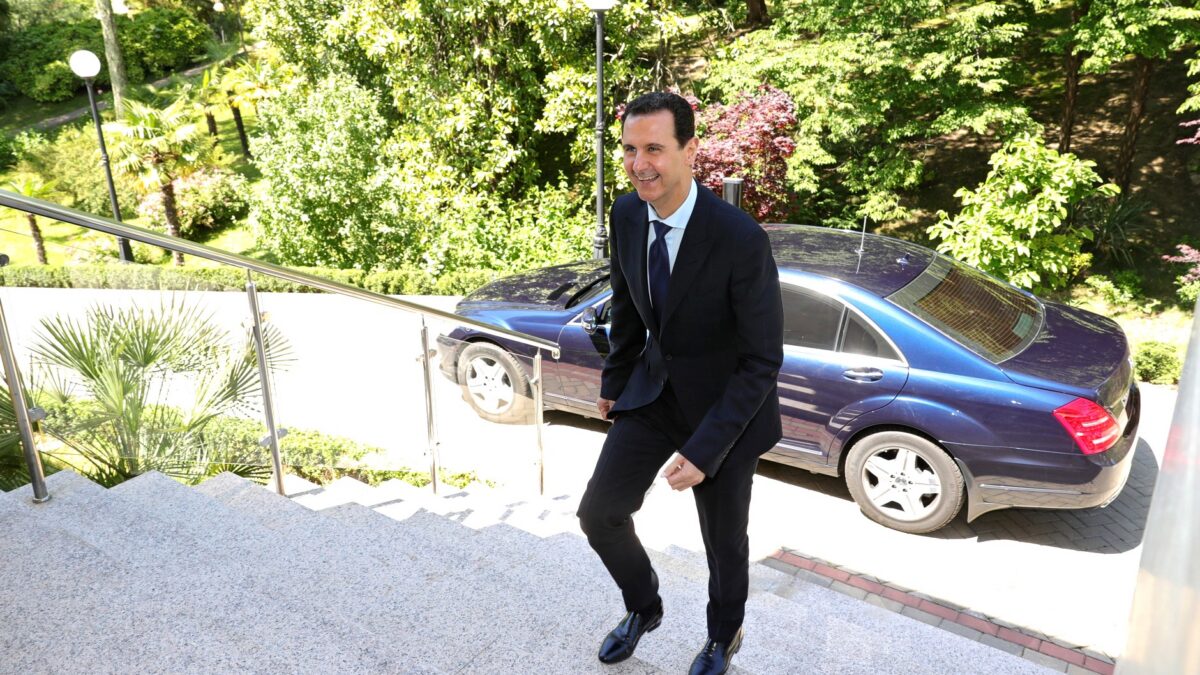
Syra's President Bashar al-Assad on Saturday received Antonio Ferrari, senior correspondent of the Italian Corriere Della Sera daily newspaper, and gave him an extensive interview.
Questions of the Italian journalist centered on the situations on the Iraqi and Palestinian arenas, the issue of fighting terrorism, the platform of the new Syrian government and relations between Syria and Italy.
Answering a question whether there is fear that Syria could become the next target for a military action after Iraq, the president said there were strong threats to Syria directly following the war, but there was not any indication that an American attack on Syria would take place.
The president said "I don't think the US will benefit from making the wrong experience in Iraq happen again. If we do feel concern, we feel more concerned of the consequences of the war which is more dangerous because the issue is not only a military invasion of a country -- but how it affects a country politically, economically, socially and historically...the war on Iraq had all those negative effects."
Answering a question on the US accusations to Syria that it produces mass destruction weapons, the president said "we responded to those accusationsÉour response was at the UN Security Council and the UN by proposing a draft resolution on making the Middle East region free of mass destruction weapons. They were angry when they accused us, and when we presented our reply their anger became greater."
Responding to a question on what he would say to the US President George W. Bush had he met him, the president said "I would have told tell him the truth about everything...I would have shown to him what was wrong with his ideas. I would have asked him first where are the Iraqi mass destruction weapons after it was proved that there were no such weapons...I would have asked him where is the democracy they spoke about in Iraq, or the better life they promised Iraqis with. So I would say the American Administration and not Syria is in a suspicious position."
The president pointed out, answering another question, that British-Syrian relations have been good since before the war on Iraq, and Britain's vision regarding the region is different from the American one. He added he didn't believe that any other country is convinced of the US accusations, or that there is another country seeking another war in the region.
Answering a question whether Syria accepts sending troops on patrolling mission along the Iraqi-Syrian borders under US command, the President said Syria sees no Iraqi acceptance of an American role, and subsequently Syria cannot take any role under the American cover because for the Iraqi citizen we will be rejected as much as the Americans are rejected.
The President added that American and British forces in Iraq are occupation troops, and subsequently this occupation must end, and this position is identical to the Syrian and Arab position, and of course the Iraqi position.
On the European-Mediterranean partnership, the president said it took a very long time, but in the last few months the two sides achieved considerable progress on technical issues and there would be new rounds of negotiations. He added that Syria asks Italy, the rotating EU president, to support Syria's position in those round of negotiations.
Answering a question on possible visits by the Italian President and Premier to Syria, the President said Europeans are always welcome in Syria, and he will avail the first opportunity to invite them to Syria.
Regarding the Palestinian situation and on a question about the roadmap, President al-Assad stressed that it doesn't actually exist among the people or the countries that would achieve peace. It only exists in the media. We in Syria see that our terms of reference is Madrid conference, but the roadmap is not based on Madrid conference. On the other hand the current Israeli government is a war government that has no interest to achieve peace and continues its assassination, killing and demolishing policy in order to foil the roadmap.
On the relations with Iraqi former President Saddam Hussein and Chairman of Palestinian Authority Yasser Arafat, the President stressed the long past dispute with Arafat regarding the peace process asserting that he told the American and European officials that isolating Arafat is a big mistake because he was elected by the Palestinians. In addition, the principle of interference in the others affairs is rejected. Our relation with Arafat whether it is positive or negative is based on our vision of peace whereby stability and security can be achieved in the region, the President added.
Regarding the Israeli threats, the President stressed that Israel is ready to carry out assassination practices everywhere so we should take the necessary measures.
And on the possibility of resuming the peace negotiations with Israel, the President stressed that there is no indicators either by words or action of such possibility because Israel has no desire to resume these negotiations.
The President asserted that the US will appoint a new Ambassador to Syria and Syria is to appoint a new Ambassador to the US.
On the occasion of the formation of the new government in Syria, the President stressed that we have big ambitions regarding the modernization project in Syria and we exert all effort to achieve that project.
Regarding the human rights in Syria, the President stressed that we are trying to enhance the law in Syria which is the responsibility of the Syrian judiciary in the first place, and it is affected by the regional situations. The US considers itself the most important democracy in the world, but we see that its democratic practices in Iraq usurping the rights of 26 billion Iraqis and forgets half million Syrian who were driven away from Golan.
On a question about the President's definition of terrorism, the President said that the lowest limit for terrorism is that the crime is terrorism, but it increase due to the increasing of the level of who carries out this terrorism and the highest level of terrorism is the state terrorism. Terrorism can't be combated by missiles but by brain and intelligence, and this is the problem of combating terrorism. There are cultural and intellectual ways to combat ignorance, wars and radicalism which are also the means to combat terrorism. The last stage for combating terrorism is the security cooperation among all countries.